From Printed Circular to the Weekly Bulletin
The weekly bulletin’s history traces how print, post and digital delivery changed its reach, helping readers see why compact updates take different forms.
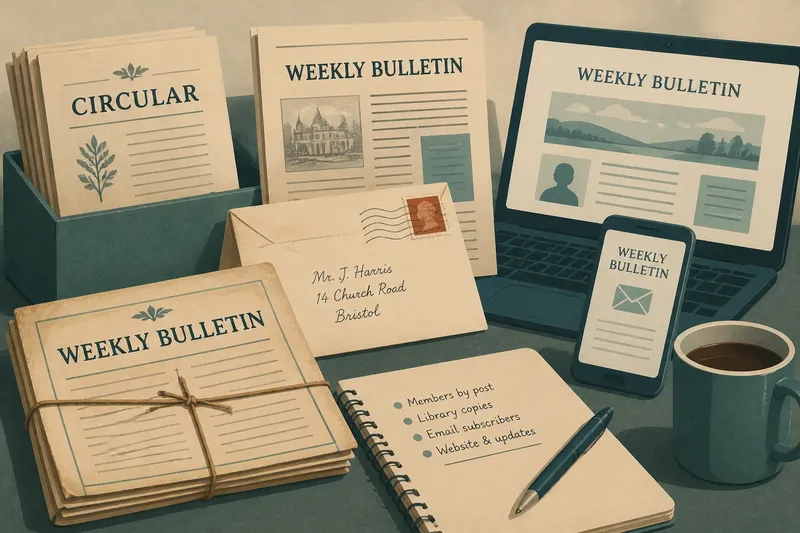
A folded circular arrives with the post, its edges softened from handling. The weekly bulletin grew from this compact publishing habit, but its history is not a simple march from paper to screen: each method of circulation shaped who could receive an issue, how it travelled and what it could contain.
Printed circulars made information portable
Printers and organisations used circulars to carry concise information to a defined group. A circular might announce a meeting, share a trade notice or report decisions to members who could not gather in person. Its compact form suited a message meant to travel, rather than a reader seeking a substantial book.
Print made a text repeatable. Once composed and set, the same notice could be reproduced for many recipients, giving a club, business or association a shared account. A copy could be handed to someone nearby or sent through the post, though delivery depended on the route and the recipient’s address.
This approach suited groups with a known membership and a reason to communicate at intervals. Someone had to decide who should receive a copy, arrange printing and distribute the sheets. A bulletin’s rhythm therefore reflected the work of producing and circulating it.
Postal bulletins joined people across distance
Surviving circulars and bulletins from different organisations show that publishers used the post to reach readers beyond their immediate locality. The form varied with the group: a society could write to members, a business could communicate with its branches, and an educational or religious body could send notices to supporters. The post offered a means of distribution, but it did not make every route equally easy or every issue equally timely.
A recurring issue also gave readers a familiar place to look for announcements, reports and upcoming events. A physical copy might be passed around a household or left in a shared room, extending its readership beyond the person whose name appeared on the address.
Unlike a live conversation, a posted bulletin arrived as a complete object. If news changed after printing, a correction might have to wait for another circular or a separate message. The publication could therefore serve as both a record of what was known when it was prepared and a channel for notices.
Printing and distribution shaped each bulletin’s audience
As printing methods developed, publishers had more options for reproducing and arranging material. A bulletin could include columns, illustrations, tables and a masthead to help readers recognise it. The printed page remained a physical object, but its appearance could signal whether it was a formal report, a practical notice or an invitation.
Distribution routes varied. Some bulletins went to subscribers or members; others were placed in shops, workplaces, institutions or public counters. A copy addressed to a member could assume the reader already knew the organisation. A stack in a waiting room needed to make its purpose clear to someone encountering it by chance.
Imagine a local horticultural society deciding between mailing a circular to its members and leaving copies at a library. The society starts with a list of members who know its name, plus library visitors who may not. It prepares one version with a renewal notice for members and another with a clear title and a short description for the library; readers can then tell which copy is meant for them, though producing two versions takes extra editorial work.
Electronic delivery changed the bulletin’s route
Email and websites removed the need to print and post every copy. Email could deliver an issue directly to a subscriber’s inbox, while a website made it available to readers who knew where to look. Direct delivery suited an opted-in list; an open page depended on readers finding it.
Digital publication also made some revisions easier. An editor could update a web page or send a corrected issue, although recipients might still keep an earlier email or printed copy. The route now passed through inbox settings, links and devices rather than postboxes and shared tables.
Each method has a different trade-off. Print offers a tangible issue that can be kept or passed on, but changes after distribution are awkward. Email reaches regular subscribers directly, but a message can be overlooked or filtered. A website can be revised and shared, yet readers may not know when a new issue appears unless they subscribe or return to check.
How should you read a weekly bulletin’s circulation history?
Why did printed circulars matter?
They let an organisation reproduce a concise message and send the same account to people who could not meet in person. Their purpose becomes clearer when you notice whether a copy names an addressee, carries a membership notice or appears intended for public distribution.
How did postal delivery shape a bulletin?
The post offered a way to send an issue beyond the publisher’s immediate surroundings, while preparation and delivery shaped its timing. A printed copy also fixed the information in the form it had when it left the publisher.
What changed when bulletins moved online?
Email and websites changed how readers received an issue and how an editor could revise it. They did not remove the need to decide what belongs in the bulletin or who is expected to read it.
What can a distribution route tell you about the intended reader?
A named address points towards direct delivery, while copies left in a shared space invite readers who may be unfamiliar with the publisher. A web address or subscription prompt can likewise signal whether the issue is meant for casual visitors or returning readers.
Circulation choices reveal the bulletin’s purpose
The history of the weekly bulletin is also a history of delivery choices: hand-to-hand exchange, post, a public stack, a subscriber list or a web page. No single route replaced all the others, because groups and readers had different needs. Paper can be passed along; email can arrive as part of a regular subscription; a website can keep a revised version available.
When comparing an old circular with a modern bulletin, look beyond the headline to the address, distribution point, mailing list or web link. Those details help show whom the publisher expected to reach and whether the issue was meant as a private notice, a shared record or an open invitation. For anyone tracing the weekly bulletin’s history, the route is not background decoration: it is part of the evidence for how the publication was meant to be read.