Brief or Roundup: Two Ways to Compress a Week
Brief or roundup? Learn how each weekly news format handles separate updates and ongoing issues, so you can choose the clearest way to catch up.
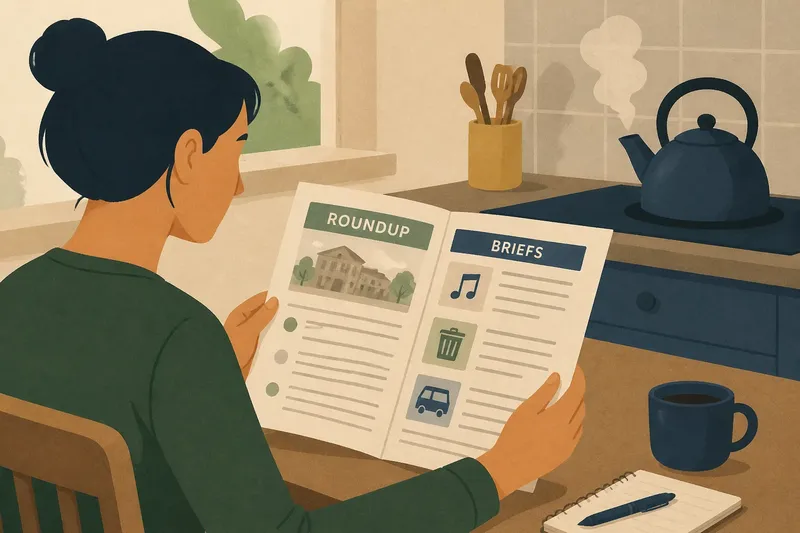
You open a weekly bulletin while waiting for the kettle to boil. A brief gives you one development to understand; a roundup helps you see what an ongoing issue looks like now. The choice between a weekly news brief and a roundup shapes not just how quickly you read, but what kind of account the bulletin offers.
A weekly news brief isolates one development
A brief is a compact, self-contained account of a single development. It names the subject, tells you what has happened and supplies enough context to make the update intelligible without requiring you to read another item.
Several briefs can sit together in a bulletin, even when their subjects have little in common. Think of them as separate containers on a kitchen shelf: each holds its own contents, and you can take down the one you need.
A roundup makes an ongoing issue its subject
A roundup gathers updates under one continuing subject, such as a council proposal, a school dispute or a local building project. Its focus is not simply the events themselves, but the current state of that subject: what is decided, what remains under discussion and what is still unknown.
That makes a roundup useful when a reader wants the shape of an issue rather than a collection of individual announcements. A well-made account distinguishes confirmed developments from unresolved points, rather than implying that a neat ending has arrived just because the week has ended.
Choose a weekly news brief or roundup by the reader’s task
Start by asking what readers need to do with the bulletin. If they want to scan several unrelated subjects and open only the items that interest them, standalone briefs are a natural fit. If they need to understand the present position on one continuing issue, a roundup can gather the relevant information in one place.
For a mixed bulletin, the formats can sit side by side. A roundup can cover the main ongoing issue, while briefs carry separate developments; clear headings tell readers what kind of account they are entering.
Say a neighbourhood bulletin must cover a library redesign, a school concert announcement and a change to rubbish collection. The editor can write a roundup about the redesign if readers need to know the current status of its unresolved access questions, then use standalone briefs for the concert and collection update. The result gives the continuing issue room without forcing unrelated notices into its account.
How do the formats affect scanning and context?
Briefs make selection easy: a reader can skip a subject without losing the meaning of the next item. That independence is especially handy in an email or on a phone, where people may read in short pauses or return to a message later.
A roundup reduces the work of gathering information about one subject from different parts of a bulletin. It may, however, ask for a more sustained read, and its broader framing should make clear which details are established and which remain unsettled.
Both formats need precise naming. If a bulletin uses “the library redesign” in one place and “the access review” elsewhere, readers may not realise the terms refer to the same issue. Choose a consistent name, and explain any change in terminology when it matters.
What should editors ask before choosing a format?
Are the updates about the same subject?
If the developments concern unrelated subjects, separate briefs usually keep them clearer. If they all concern one continuing issue, a roundup may help readers see its present state without searching across the bulletin.
Can each item stand alone?
If a reader can understand an update with a short explanation inside that item, it can work as a brief. If its meaning depends on information scattered elsewhere, consider gathering the material into a roundup or adding the missing context.
What does the reader need to know now?
If the immediate development is the main point, a brief can put it first and keep the account focused. If the reader needs a clear account of what is settled and what is still open, a roundup can make those distinctions visible.
Could the framing suggest more certainty than the facts allow?
If a roundup groups events under one subject, check that it does not imply an unreported connection between them. Attribute claims clearly and distinguish a confirmed decision from a proposal, response or unanswered question.
A roundup should make the current position clear
Editors can use these checks before publishing a roundup. Each one links an observable feature to a decision, with an alternative action if the check raises a problem.
- Subject: Check that the headline and opening name the same issue; if they do, keep them, but if they point to different subjects, revise one before publication.
- Status: Check whether each item is a proposal, decision, response or unresolved question; if the status is clear, retain the wording, but if it is blurred, name the correct status.
- Attribution: Check that claims identify who made them; if the source is clear, keep the attribution, but if it is missing, add it or remove the unsupported claim.
- Connections: Check whether the wording says or implies that one event caused another; if the reporting supports that link, explain it, but if not, describe the events separately.
- Current position: Check whether the ending tells readers what is settled and what remains open; if both are clear, keep the ending, but if either is missing, add the relevant status or unanswered point.
- Useful detail: Check whether each paragraph changes the reader’s understanding of the issue; if it does, keep it, but if it only repeats information, cut it or replace it with a detail that clarifies the present position.
How can a roundup stay concise without becoming vague?
Keep the details that explain the issue’s current state and remove those that do not change it. A short account still needs enough context for a reader to understand why a point is settled, disputed or pending.
For each sentence, ask whether it clarifies the subject, its present status or an open question. If not, it may be expendable; if removing it makes the account hard to follow, retain the point and tighten the wording.
Plain language also helps distinguish reporting from judgement. “The committee has not issued a decision” describes a status; “the committee has finally acted” adds an evaluation that may not be supported by the account.
Which format suits a quick catch-up?
For a quick scan across different subjects, choose the briefs. For a clear account of where one continuing issue stands, choose the roundup. If both appear in the same bulletin, use the headings to find the format that fits the question you have in mind.
The choice between a weekly news brief and a roundup is ultimately a choice about the reader’s task: picking out separate developments or understanding the present state of one issue. When you read, notice whether the format gives you enough information to tell what is settled, what remains open and which details belong together.